

SOC 2 Type II: How SMBs Can Vet an MSP Without Getting Stuck in Security Questionnaires
If you’ve ever tried to hire a managed service provider (MSP) or security partner, you’ve likely run into the same bottleneck: vendor due diligence. The spreadsheet. The questionnaires. The “please attach evidence” emails that stretch on for weeks.
For small and midsize businesses (SMBs), this process can become a deal-stopper—not because you don’t care about security, but because you don’t have the time or internal staff to run enterprise-grade assessments.
That’s where SOC 2 Type II can make a real difference. Not as a buzzword, but as a way to reduce friction and build trust faster—especially when the vendor is an MSP with privileged access to your systems.
Why security questionnaires slow down SMB buying decisions
Security reviews tend to slow things down for three reasons:
- Too many stakeholders: IT, operations, leadership, compliance, and sometimes insurers all weigh in.
- Evidence takes time: It’s one thing to answer “Yes, we use MFA.” It’s another to prove it across tooling, users, and access policies.
- Process gets messy: SMBs often rely on ad-hoc checks instead of a consistent vendor review workflow.
When the vendor is an MSP, the stakes feel higher—because you’re not only buying a service. You’re granting access.
What SOC 2 Type II means (plain English)
SOC 2 is an attestation framework developed by the AICPA to help service organizations demonstrate that they manage systems and data responsibly.
A SOC 2 Type II report is an independent CPA firm’s assessment that confirms not only that security controls are designed appropriately, but also that they operated effectively over a period of time (often several months). In practical terms, Type I is a snapshot at a point in time, while Type II shows consistent execution over time.
SOC 2 is not typically required by law, but it is often requested by customers (or required by contract) as a proof-of-trust signal—especially when a provider has privileged access to systems and sensitive data.
Why SOC 2 Type II matters specifically when you hire an MSP
An MSP is different from a typical vendor because an MSP often:
- Administers endpoints, identities, backups, and security tools
- Has elevated permissions across critical systems
- Acts as an extension of your IT and security operations
- May handle data that’s sensitive (and regulated) in certain industries
So when you evaluate an MSP, you’re evaluating more than their tool stack. You’re evaluating their people and processes.
SOC 2 Type II is one of the strongest “trust signals” available because it’s designed to validate exactly that: operational discipline.
What SOC 2 covers—and what it doesn’t
SOC 2 audits are based on “Trust Services Criteria” (TSC). Most MSPs start with the Security criteria and may expand over time.
SOC 2 typically helps validate areas like:
- Access control (identity, authentication, least privilege)
- Monitoring and logging
- Incident response planning
- Change management
- Vendor management
- Policy governance and security training
- Data protection practices
What SOC 2 does not do:
- It does not guarantee your business will never be breached
- It does not automatically certify your environment (it’s about the provider’s controls)
- It does not replace good-fit scoping and contract terms
SOC 2 is best used as a baseline that reduces uncertainty—not as the only evaluation criterion.
How to use SOC 2 to shorten vendor due diligence (practical steps)
If an MSP is SOC 2 Type II verified, you can often accelerate due diligence by shifting from “prove everything” to “verify what matters.”
Here’s a practical approach SMBs can use:
- Request the SOC 2 Type II report under NDA
Many providers share the report only under a confidentiality agreement—and that’s standard. - Focus your questions on “exceptions” and scope
Ask:- What was in scope for the audit?
- Were there any exceptions noted?
- What remediation steps were taken (if any)?
- What was in scope for the audit?
- Map the report to your real risks
If you’re concerned about ransomware, backups, and response time, don’t get stuck on generic policy language. Make sure the provider’s controls align to your specific threats. - Use a short questionnaire for what SOC 2 doesn’t answer
For example:- How do they handle after-hours escalation?
- What does onboarding/offboarding look like?
- What are the boundaries of responsibility (client vs MSP)?
- How do they handle after-hours escalation?
A simple “fast-vet” checklist for SMBs hiring an MSP
If you want a concise way to evaluate whether an MSP is safe to trust, ask these questions:
- Access & identity: Do you enforce MFA everywhere and review access regularly?
- Endpoint security: Do you have EDR/MDR coverage across managed devices?
- Monitoring: Do you actively monitor logs and alert on suspicious activity?
- Incident response: Do you have a documented plan—and do you test it?
- Backup & recovery: Do you verify backups and test restores routinely?
- Change management: Are changes tracked, approved, and documented?
- Vendor discipline: Do you track third-party vendors and security posture?
- Evidence: Can you show proof, not only say “yes”?
If the provider is SOC 2 Type II verified, the report often supports many of these areas with formal evidence—making the “proof” portion faster.
Where Lumen21 fits (and how to request proof safely)
Lumen21 is SOC 2 Type II verified and can provide the audited SOC 2 Type II report under NDA for clients it supports. For SMB buyers, this acts as a practical trust signal because it shows that key security controls and operating procedures are not only documented, but also consistently executed and independently assessed over time.
That matters because it indicates mature operating practices—not only security tools. For SMB buyers, it can help reduce vendor review friction and speed up internal approval.
If you’re in a regulated environment (or simply want enterprise-grade assurance without enterprise complexity), you can use a SOC 2 Type II report as a shortcut to confirm that an MSP’s security controls are both documented and consistently executed.
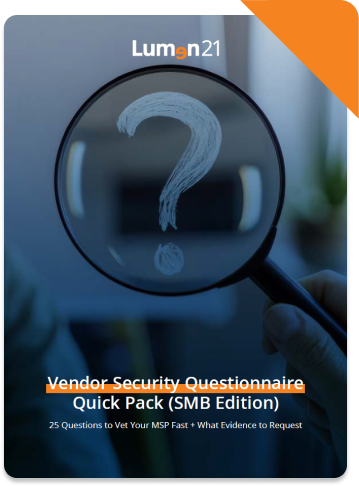
Download: Vendor Security Questionnaire Quick Pack
To make the vetting process easier, we recommend using a short, structured approach.
- A 1–2 page “fast-vet” checklist SMBs can use to evaluate an MSP
- A short evidence request list (what to ask for and why)
A simple scope/boundaries worksheet so responsibilities are clear up front
SOC 2 Type II is not just a compliance badge. For SMBs, it’s a practical way to:
- Reduce vendor due diligence time
- Get credible evidence of security and process maturity
- Hire an MSP with clearer, more reliable operational discipline
If you want to see how SOC 2 Type II applies to your business and what it means for your vendor risk,